

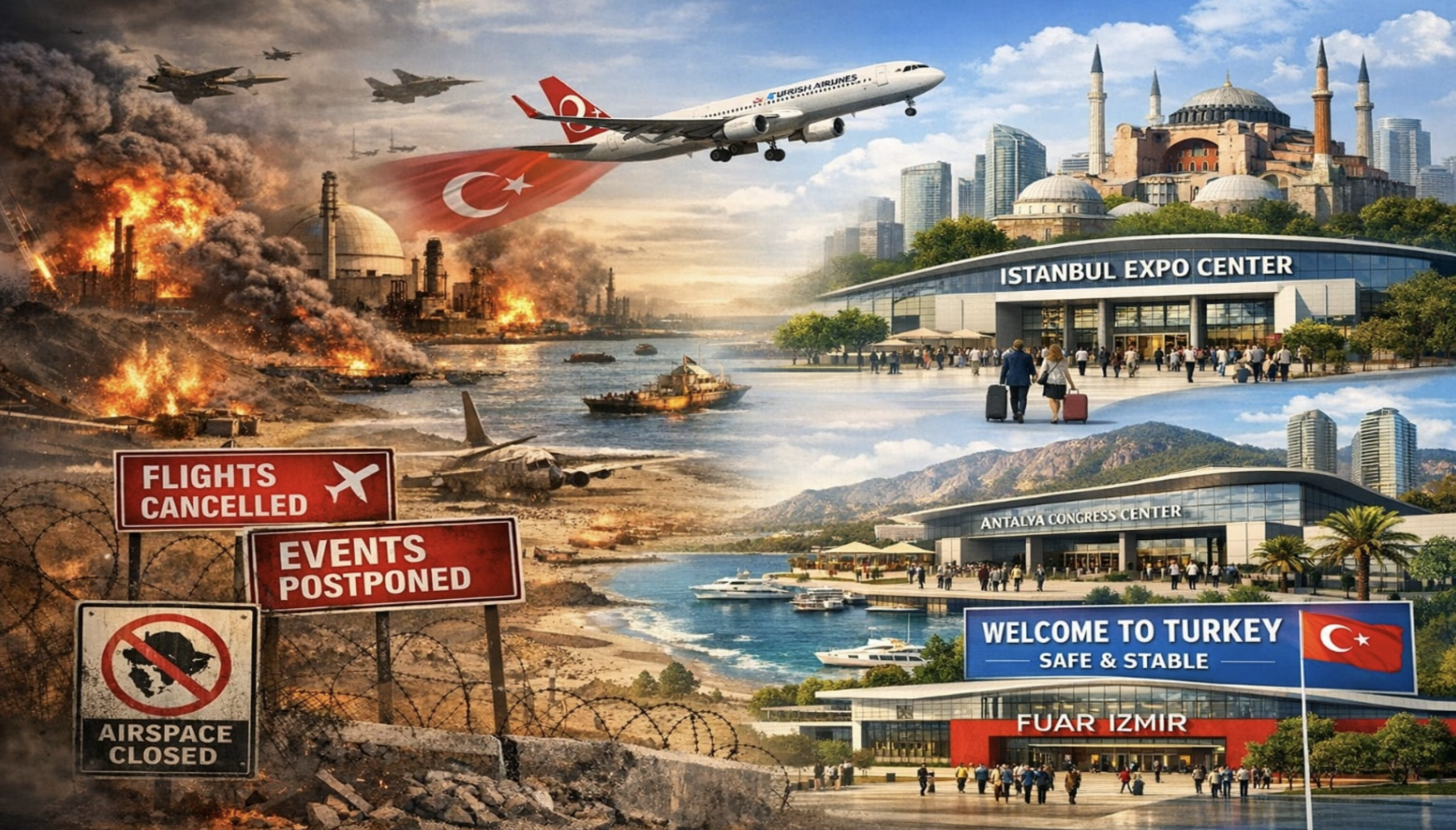
Turkey`s opportunity to become a global exhibition hub following the 2026 Middle East Conflict
Geopolitical Fracture After the 2026 Middle East War and Turkey's Opportunity to Become an Alternative Hub in the Global Exhibition Industry
The large-scale air operations carried out by the United States and Israel against military and nuclear facilities in Iran on February 28, 2026, have not only triggered a regional conflict but have also fundamentally shaken the stability of the Persian Gulf, one of the most critical hubs for global trade and the MICE (Meetings, Incentives, Conferences, and Exhibitions) industry. As of March 15, 2026, in the two weeks since the conflict began, the ecosystem of fairs, congresses, and sporting events in the region faces the risk of irreparable damage. The loss of operational sustainability in a kinetic war environment, particularly for cities built on the identity of "global meeting points" like Dubai, Doha, and Abu Dhabi, has pushed industry representatives into an urgent search for alternatives. This analysis examines the structural challenges faced by the exhibition industry in the Middle East amidst the current conflict and presents, with technical, economic, and strategic data, why Turkey (Istanbul, Antalya, Izmir) has become the strongest alternative for this massive market.
Anatomy of the Regional Conflict and the First Blow to the Events Industry
The military operation that began on February 28, 2026, instantly paralyzed civilian infrastructure and transportation networks in the region. Initially conceived as targeted strikes, the operations expanded with Iran's retaliatory attacks on points hosting American military presence in Bahrain, the United Arab Emirates, and Saudi Arabia. This has not only compromised the physical security of exhibition and congress centers in the region but also collapsed the "hub" model that ensures participant access to the area.
Airspace Closures and Chaos in the Aviation Sector
International accessibility, the cornerstone of the MICE industry, was completely eliminated by the beginning of March 2026. EASA (European Union Aviation Safety Agency) issued clear recommendations for flight information regions (FIRs) covering the airspaces of Bahrain, Iran, Iraq, Israel, Jordan, and the UAE, advising "not to use them at any altitude." As a direct result, approximately 21,300 flights were canceled at major airports in the region, stranding tens of thousands of fair participants and exhibition equipment.
Country / Region Airspace Status (As of March 15, 2026)
Operational Impact
United Arab Emirates Controlled and Limited 30%+ capacity loss at Dubai and Abu Dhabi airports
Qatar Closed / High Risk All public events in Doha suspended
Bahrain Completely Closed Large-scale events like F1 canceled
Saudi Arabia Partial Air Traffic Risky due to attacks on oil infrastructure
Turkey Open / Strategic Transit Serving as a regional transfer and evacuation hub
While Turkish civil aviation authorities suspended flights to Iran, Iraq, Syria, Lebanon, and Jordan until mid-March due to security risks, Istanbul Airport became the primary evacuation point for business representatives and diplomatic missions fleeing the region. Compared to other major regional airlines (Emirates, Qatar, Etihad), Turkish Airlines demonstrated much more resilient performance, maintaining operations with only an 8% reduction in flight traffic.
Canceled and Postponed Global Events
The wave of cancellations immediately following the conflict almost completely wiped out the region's 2026 events calendar. Formula 1 Grand Prix races in Bahrain and Saudi Arabia were canceled, citing the "safety and well-being of the community," with no substitute races scheduled. The "Affiliate World Global" fair, planned to open on March 4 in Dubai and expecting 7,000 participants, was postponed to 2027; the 13,000-person "Megacampus Summit" was rescheduled for September. In Qatar, all public events and hotel entertainment were indefinitely halted, leading to the cancellation of prestigious organizations like the "Longines Global Champions Tour."
Structural and Legal Barriers to Organizing Exhibitions in the Gulf Region
As of March 15, 2026, even if the conflict were to end, significant structural barriers make it difficult to hold fairs again in Dubai, Doha, or Riyadh. These challenges are not only military but also financial, legal, and psychological.
Force Majeure and Contractual Deadlocks
Energy producers and commercial entities in Gulf countries have begun extensively invoking the "Force Majeure" clause due to the attacks. For fair organizers, this means millions of dollars in stand investments, rental fees, and sponsorship agreements are plunged into legal uncertainty. Differences in defining an event as "war" or "armed conflict" lead to major disputes in insurance payouts and contract terminations.
Legal experts note that the fact the US Congress did not issue a formal declaration of war exacerbates difficulties in the private sector. Organizers, unable to fulfill their obligations to participants due to this extraordinary event beyond human control, also cannot claim compensation from venue operators.
Insurance Costs and the Accessibility Problem
The insurance market describes the 2026 war as "the biggest shock to the sector since the COVID-19 pandemic." "War Risk" premiums for travel and cargo insurance to the region have increased dramatically.
Insurance Item Rate Increase / Status Sectoral Impact
Maritime Cargo (War Risk) 1000%+ Passage of fair equipment through the Strait of Hormuz became impossible
Aviation Insurance Hundreds of Thousands of Dollars Daily Extra Premium Exorbitant price increases for participant flight tickets
Event Cancellation Insurance Capacity Contraction / Cancellations Organizers left without financial security
Some insurance companies have begun canceling coverage for ships passing through the Strait of Hormuz and events in the region with 72-hour notice. The financial predictability required for a successful fair has completely disappeared due to this volatility. Investors and participating companies are avoiding the region not only because of the physical attack risk but also due to the risk of being uninsured.
Supply Chain and Logistical Deadlock: Closure of the Strait of Hormuz
The Strait of Hormuz is the main transit route for 20% of the global oil supply, as well as commodities like aluminum, steel, and fertilizers vital for the construction and exhibition sectors in the region. The de facto closure of the strait and the suspension of sailings by major container lines like Maersk, MSC, and CMA CGM have made it impossible to supply materials needed for setting up exhibition stands.
"Conflict Surcharges" were implemented immediately after the war began, increasing freight rates by more than 55%. Fires and drone attacks at major logistics hubs like Jebel Ali Port in Dubai have paralyzed operational capacity. This has made the fundamental principle of "timely logistics" for a fair impossible, forcing events to shift to regions like Turkey, which have land routes and alternative sea routes (Mediterranean).
Cultural Damage and Loss of Soft Power
Over the last decade, Middle Eastern cities had positioned themselves not only as trade hubs but also as global art and culture centers. However, the 2026 conflict has created a "cultural shockwave" shattering this image. Damage to Golestan Palace in Tehran, and the ancient city of Tyre and the Al-Bass archaeological site in Lebanon being affected by attacks, have mobilized UNESCO and the international community.
The closure of galleries in contemporary art districts like Alserkal Avenue in Dubai, the suspension of activities at Louvre Abu Dhabi, and universities switching to distance learning have made the region lose its appeal for the "creative class" and "knowledge professionals." While the vibrancy of a destination's social and cultural life is a significant motivation for fair participants, current security concerns and rising anti-Western sentiment have sharply curtailed the appetite for travel to the region.
Turkey: Safe Haven and Strategic Alternative in the Midst of Crisis
The chaos in the region has created a historic opportunity for Turkey (Istanbul, Antalya, and Izmir) to become a new center of attraction in fair and congress tourism. With its geographical location and experience in crisis management, Turkey is the most rational address for the capital and event traffic fleeing Dubai and other Gulf hubs.
Istanbul: The Unshakeable Bridge Between East and West
Istanbul proved its potential to assume this role with EMITT (Eastern Mediterranean International Tourism and Travel Fair) held in early 2026. Hosting 552 participants from 109 countries and generating a business volume exceeding 500 million euros, this fair showcased the global standards capacity of the Istanbul Expo Center (IFM).
Istanbul Expo Center (IFM) and Technical Capacity
With a total area of 162,000 square meters and over 100,000 square meters of indoor exhibition space, IFM is at a level to compete directly with the Dubai World Trade Centre (DWTC). Especially its column-free, high-ceilinged halls and modern logistics ramps technically make it possible to transfer heavy industry and technology fairs from the region to Istanbul.
Istanbul Expo Center (IFM) Dubai World Trade Centre (DWTC)
Total Indoor Space 100,000+ m² 100,000+ m²
Airport Access 35-45 min (IST) 15 min (DXB) - Risky due to war
Occupancy Rate 100% (Business District) Uncertain (Postponed Events)
Security Status Safe / Stable High Risk / War Zone
Istanbul's strategic advantage is not limited to venue capacity. Integrated accommodation facilities in the city, such as WOW hotels, allow participants to stay within the event area without security concerns. Additionally, Tüyap Fair and Congress Center, with its capacity of 120,000 square meters, is also capable of absorbing massive international organizations.
Antalya: The Winter Base for World Leaders and Specialty Fairs
Antalya is not only known for sea-sand-sun tourism but is also the heart of the "Qualitative and Year-Round Tourism" strategy, thanks to the massive congress centers in its five-star hotels. During the 2026 Middle East war, the closure of luxury hotels and congress centers in the Gulf made Antalya the number one choice, especially for medical, technology, and diplomacy summits.
Advantages offered by Antalya:
- Capacity: Five-star hotels with high occupancy rates even in winter months and integrated conference halls.
- Cost Effectiveness: Compared to the soaring insurance and logistics costs in Gulf countries, Antalya's "all-inclusive" congress packages are a financial lifeline for international associations.
- Security: Its geographical distance from the conflict zone and its location under the NATO air defense umbrella provide a psychological safe haven for participants.
Izmir: The Rising Star for Specialized Industry and Sustainability Fairs
Fuar Izmir, with a total area of 330,000 square meters and modern architecture, is one of Turkey's largest fairgrounds. Particularly in specialized fields like marble, textiles, and agricultural technologies, Izmir stands out as a natural alternative to similar themed fairs in the Gulf region (e.g., construction fairs in Saudi Arabia). The logistical conveniences and port connections offered by Izmir provide a safe route for participants bringing equipment by sea without entering the Strait of Hormuz.
Sectoral Analysis: Which Fairs Pose a Potential for Shifting to Turkey?
Due to the nature of the geopolitical crisis, the relocation of fairs in certain sectors to Turkey has become a necessity rather than a choice.
1. Health and Medical Tourism Fairs
Turkey is already positioned as a global health tourism center. The fact that the "Health Tourism Special Section" was the most popular part of EMITT 2026 proves the potential of this field. Major events like "World Health Expo 2026," planned for Dubai, are expected to move to Istanbul or Antalya due to Turkey's advanced hospital infrastructure and specialist physician staff.
2. Technology and Digital Transformation (The TOKEN2049 Example)
Dubai's vision of becoming a crypto and technology hub has been severely damaged by the cancellation of fairs like TOKEN2049. Technology investors demand uninterrupted internet access and physical security. Istanbul, with its young population and rapidly growing technoparks, has the capacity to consolidate Gulf technology summits under an "Istanbul Tech Week" concept.
3. Energy and Solar Technologies
Attacks on oil facilities in the region (Bahrain refinery, Kharg Island) have shifted the energy sector's focus to "energy security and renewable energy." Solarex Istanbul 2026, Turkey's first and only solar energy fair, is poised to become the new meeting point for energy giants from the Gulf.
4. Aviation and Defense Industry
Aviation fairs in the Gulf region (Dubai Airshow, etc.) have become risky for civilian participants due to military activity. Turkey's drone projects with giants like Baykar and Leonardo, and its national combat aircraft program, are propelling defense fairs (like IDEF) to the top of the global calendar.
2026-2030 Projection: Future Scenarios and Futuristic Analysis
Geopolitical risk analysts predict that the effects of the 2026 war in the Middle East will create an "axis shift" lasting a decade. The future scenarios outlined as of March 15, 2026, are as follows:
Scenario A: Permanent Regional Instability and Turkey Becoming a "Mega-Hub"
If the war continues until the end of 2026, global fair organizers (Informa, Reed Exhibitions, etc.) will downsize their offices in Dubai and Doha and shift their operation centers to Istanbul. In this case, Turkey will not only be a regional alternative but will become a global MICE leader competing with London and Frankfurt.
Scenario B: Rapid De-escalation and Hybrid Model
Even if the conflict de-escalates quickly, the "security premium" will continue to be part of fair costs. Organizers might develop "Dubai-Istanbul" partnership hybrid fair models to distribute risks. However, financial data shows that capital favors safe havens, and Turkey will take the lion's share in this process.
Economic Impact and Growth Estimates
The spending of a visitor participating in MICE tourism is 3 to 4 times higher than that of a regular tourist. It is forecasted that Turkey's number of fair visitors in 2026 will exceed 20 million, and the revenue from this sector will approach 25% of total tourism revenues. This will serve as a strategic lever in closing Turkey's current account deficit.
Year Number of Fair Visitors Economic Contribution (Billion $)
2024 18 Million (Actual) 12
2026 22 Million (Projected) 18
2028 26 Million (Strategic Target) 25
2030 30 Million (Vision 2030) 35
Conclusion and Strategic Recommendations
As of March 15, 2026, the geopolitical landscape in the Middle East proves that the exhibition industry can no longer return to the "old normal." The grandeur offered by Dubai as an exhibition venue has become ineffective against the logistical and insurance barriers created by kinetic warfare. Turkey, with its modern infrastructure offered by the triangle of Istanbul, Antalya, and Izmir, THY's unshakeable flight network, and agility in crisis management, is the sole actor capable of filling this gap.
Recommendations for Decision Makers:
- Logistical Assurance: Organizers should prioritize Turkish routes, which are not dependent on the Strait of Hormuz and have strong land connections, as their primary choice.
- Insurance Arbitration: Istanbul should be chosen as the "Arbitration Center" in international fair contracts, thus avoiding the legal chaos in the Gulf.
- Aviation Collaborations: By making block seat and special cargo agreements with THY and other Turkish carriers, participant transportation costs should be stabilized.
- Cultural Diplomacy: Turkey's "Safe Zone" image should be reinforced with international campaigns, and it should host cultural events fleeing the region.
In conclusion, the 2026 war is redrawing the global trade map. On this new map, Turkey is positioned not merely as a transit point, but as the world's safest and most modern trade stage. Managing this historic opportunity with a strategic vision will propel Turkey to the top of the global exhibition league by 2030.